Step 2 of 20 · Act 1 · Why revolution happened
Absolute monarchy
Power that came from God — in theory
The king claimed absolute authority from God, but in practice his power was limited by entrenched privileges and law courts he could not easily override.
At the top of the old order stood the king. In 1774, Louis XVI inherited a throne built on a powerful idea: that the king's authority came directly from God. This was called the divine right of kingsThe belief that a king's authority comes directly from God, so he answers to God rather than to the people.. A monarch who ruled by divine right did not answer to voters or to a parliament. He answered, in theory, only to God.
France had once had a national assembly, the Estates-GeneralFrance's national assembly, representing the three estates. It had not been called since 1614., that could be called to advise the king. But it had not met for 175 years — not since 1614. There was no regular, elected body that could check the king's decisions or approve new taxes on behalf of the nation.
This sounds like total power. In practice, it was messier. The king could not simply command whatever he wished. Powerful law courts called parlementsA powerful royal law court (not an elected parliament). It had to register the king's decrees, and could resist them. had to register royal decrees before they became law, and they often resisted. Regions, towns, and groups held ancient privileges the king was expected to respect. Change was slow and tangled.
So absolute monarchyA system in which the monarch holds supreme power and is not limited by an elected parliament. created a trap. The king was blamed when things went wrong, because he claimed to rule alone. But he could not easily push through reforms, because the system was full of people and institutions defending their own rights. Louis XVI would spend his reign caught in exactly this trap.
What matters here
Absolute monarchy meant no elected body checked the king — yet he still could not force through change. He carried the blame without the freedom to reform.
Historical source
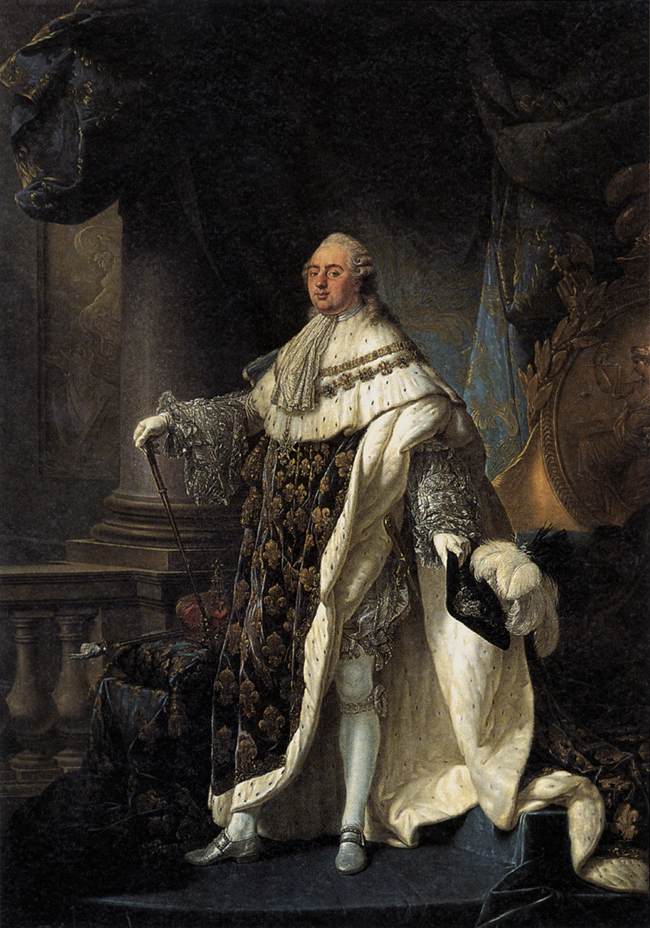
The king as he wished to be seen: absolute, God-given majesty — the image the Revolution would dismantle.
Louis XVI in coronation robes — Antoine-François Callet, c. 1789.
Public domain · Wikimedia Commons
Misconception check
“Absolute monarchy meant the king of France could do absolutely anything he wanted.”